
Strategic Integration of Sensor-Equipped Wall Lighting to Elevate Safety in Contemporary Design
In the evolving landscape of modern interiors, especially within children’s rooms and elegant salons, the deployment of wall-mounted lighting equipped with sensors has transitioned from a convenience to a critical safety element. As professionals in lighting design and electrical systems recognize, the precise placement of such fixtures can significantly mitigate risks while enhancing ambient functionality.
The Complexity of Sensor Placement: A Multidimensional Challenge
One of the core issues in optimizing wall-mounted sensor lighting lies in understanding the interplay between sensor hardware capabilities, room architecture, and user behavior patterns. According to recent studies in Space Design Magazine, the effective field of detection for PIR sensors is influenced by room dimensions, obstacle placement, and interior materials, which in turn affects sensor responsiveness and safety margins.
Maximizing Safety Through Expert Placement Guidelines
Experts recommend positioning sensors at height levels that balance unobstructed detection fields with aesthetic considerations. In children’s bedrooms, for example, wall-mounted sensors should be installed at approximately 150 cm from the floor, avoiding typical furniture placement that could create blind spots. Additionally, choosing locations near entry points ensures activation upon occupant arrival, thereby preventing accidental trips or falls. For luxurious salons or commercial spaces, sensor coverage must be calibrated to accommodate high ceilings and complex layouts, often requiring a combination of wall-mounted and ceiling sensors for comprehensive safety.
Emerging Technologies and Their Impact on Safety Protocols
Advancements such as dual-technology sensors combining PIR and microwave detection enable more precise activation zones, reducing false positives and blind spots. Integrating these with smart home systems allows dynamic adjustments based on occupancy patterns, further aligning safety with convenience. Industry leader U.S. Department of Energy emphasizes that optimal sensor placement is key in energy-efficient and safe lighting designs, underscoring the importance of expert planning at the installation stage.
What are the critical factors that influence the optimal placement of wall-mounted sensors in multifaceted spaces like children’s rooms and professional salons?
Achieving safety and maximum efficiency requires a nuanced understanding of sensor technology, interior architecture, and occupant behavior—all deeply rooted in expert knowledge and meticulous planning. For those seeking to deepen their expertise, exploring our detailed guide on balancing functionality and design in lighting placement is highly recommended. Your feedback and insights could contribute to advancing safety standards in lighting implementation.
Unveiling the Power of Layered Lighting for Dynamic Spaces
In modern interior design, layering different types of lighting is essential to create versatile and inviting atmospheres. Combining ambient, task, and accent lighting not only enhances functionality but also adds depth and character to any space. For instance, integrating recessed ceiling lights with stylish wall sconces can dramatically alter the perception of a room’s size and ambiance. To achieve the perfect balance, consider how each layer interacts and complements the others, ensuring that illumination adapts seamlessly to different moods and activities. Explore innovative ideas, such as smart dimming systems, that allow you to adjust lighting intensity effortlessly, tailoring the environment to your needs. A well-executed layered lighting scheme is crucial for spaces like living rooms and kitchens, where diverse activities and aesthetic impressions intersect.
What Is the Role of Color Temperature in Setting the Correct Mood?
Color temperature, measured in Kelvin (K), plays a decisive role in influencing the emotional tone of a room. Warm white light (around 2700K to 3000K) fosters coziness and relaxation, making it ideal for bedrooms and lounges. Conversely, cooler white (4000K to 5000K) invigorates energy and is suitable for workspaces and kitchens where clarity is paramount. Selecting the appropriate color temperature is not merely a matter of preference but a strategic decision impacting well-being and productivity. For example, in bedrooms, avoiding overly harsh light can promote restful sleep, while in home offices, brighter, cooler lighting can enhance concentration. To achieve harmony between aesthetics and function, some designers recommend mixing color temperatures within a space to define zones and create visual interest.
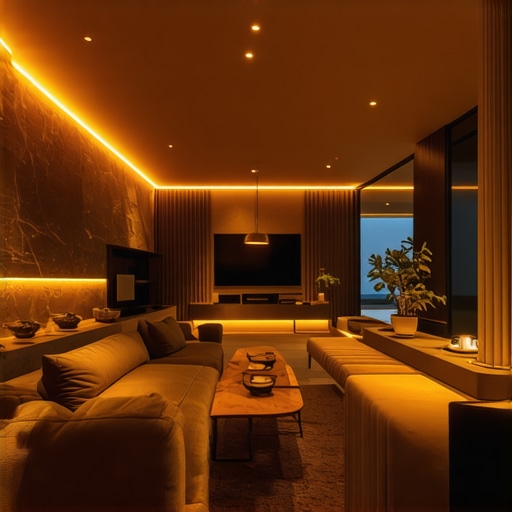
Image prompt: Modern interior with layered lighting, including recessed, wall sconces, and pendant lights, showcasing warm and cool tones.
Can Ambient Lighting Be Both Practical and Artistic?
Absolutely. Ambient lighting transcends mere illumination; it has the potential to serve as an artistic statement while fulfilling its primary function of setting the overall mood. Skilled designers often incorporate sculptural fixtures, vintage-inspired pendant lamps, or custom-made LED installations to add a creative dimension. This approach transforms a standard living room into a gallery of light, emphasizing architectural features and decorative elements. The key lies in balancing aesthetic appeal with sufficient brightness, ensuring that the space remains functional without sacrificing style. As illuminated by the innovative work on retro and vintage lighting, incorporating unique fixtures can evoke nostalgia while maintaining modern comfort levels.
For enthusiasts eager to push their design boundaries, experimenting with indirect lighting techniques—such as concealed LED strips—can create a soft, diffuse glow that enhances ambiance without overwhelming the senses. This method is increasingly popular in hospitality and luxury residential projects, where atmosphere directly impacts experience.
Interested in more tips for elevating your interior design? Share your ideas or questions below—we love to inspire and learn from our community!
Expert insights into layered lighting and color management continue to evolve. According to industry leaders, understanding the nuanced interplay of light sources and color temperature is paramount for achieving the desired spatial feel. Delving into advanced techniques can significantly uplift your project, making spaces not just lit but truly alive with character and purpose.
Revolutionizing Sensor Placement Strategies to Combat Blind Spots
Industry experts increasingly recognize that precise placement of sensor fixtures can dramatically reduce safety hazards such as accidental trips or concealed obstructions. Advanced algorithms now inform optimal installation points, analyzing room geometry and furniture layouts for maximum detection coverage. For instance, integrating 3D modeling tools enables designers to simulate sensor fields of detection dynamically, accommodating future interior modifications. This proactive approach not only enhances safety but also ensures aesthetic integrity, preventing bulky sensor obstructions that compromise interior harmony.
Can Adaptive Sensors Overcome Static Placement Limitations?
Emerging adaptive sensor technologies incorporate machine learning algorithms to dynamically adjust detection zones based on occupant behavior patterns and environmental changes. According to a comprehensive publication by the IEEE Transactions on Industrial Electronics, these intelligent systems significantly reduce false positives and blind spots, offering a game-changing solution to traditional static positioning challenges. Moreover, seamless integration with smart home ecosystems enables real-time recalibration, providing a responsive safety net that adapts to evolving space configurations.
Synergizing Sensor Technologies for Cohesive Safety Networks
Blending PIR sensors with microwave or ultrasonic detection can create a layered safety net that adapts to complex environments. Strategically deploying these dual or triple-technology sensors allows for cross-validation of occupant movement, increasing reliability. Such configurations are especially vital in large, multi-room spaces like salons and multi-purpose child zones. As highlighted by industry standards from the National Fire Protection Association, the fusion of different sensor modalities not only improves safety but also offers granular control over lighting activation, energy efficiency, and user comfort.
Innovations in Aesthetic Integration and User Experience
Designers are now exploring minimalist sensor designs that discreetly blend into wall surfaces, employing materials such as frosted glass or matte finishes. Furthermore, the advent of customizable sensor housings compatible with interior themes enables seamless aesthetic integration. For example, in high-end salons, sensors embedded within decorative panels or wall art can maintain visual harmony while delivering optimal safety functionality. This approach aligns with the trend toward invisible technology, where safety features are unobtrusive yet highly effective—enhancing both the visual appeal and safety standards of the space.
Enhancing Safety Protocols with Intelligent Lighting Control Systems
Integrating sensor data with intelligent lighting control systems offers real-time ambient adjustments responsive to occupant presence. These systems can preemptively activate or deactivate lighting, adjust brightness levels, and even modify color temperatures to complement safety protocols. For example, in children’s rooms, dimming lights gradually as a child enters can reduce startling effects, fostering a calming environment. As technological capabilities progress, experts foresee wider adoption of such integrated systems, leading to smarter, safer, and more personalized living and commercial spaces.
To delve deeper into the interplay between advanced sensor technologies and interior safety solutions, consult industry-specific case studies such as those published by the Illuminating Safety Association. Embracing these innovations will elevate your projects from merely compliant to cutting-edge in safety and aesthetics—are you ready to incorporate these pioneering strategies?
Leveraging Spatial Analytics for Superior Sensor Deployment Strategies
In the quest for impeccable safety within complex environments such as children’s zones or high-end salons, the application of advanced spatial analytics has become indispensable. By employing 3D environmental modeling and real-time occupancy data, designers can pinpoint optimal sensor locations that preempt blind spots and accommodate architectural idiosyncrasies. This data-driven approach transcends traditional heuristics, allowing for customization tailored to specific spatial configurations, furniture arrangements, and dynamic occupant behaviors. Industry-specific tools like Building Information Modeling (BIM) platforms have integrated sensor placement simulations, offering a holistic view that aligns safety imperatives with aesthetic goals.
Harnessing AI and Machine Learning to Evolve Sensor Calibration
As artificial intelligence (AI) advances, sensor calibration processes are transitioning from static setups to adaptive systems capable of learning occupant movement patterns. Machine learning algorithms analyze variability in detection efficacy over time, adjusting sensitivity thresholds and detection zones autonomously. This paradigm shift ensures sustained optimal coverage, reduces false activations, and mitigates the need for frequent manual recalibrations. For instance, in luxurious salons requiring precise activation zones around delicate fixtures, AI-powered sensors can differentiate between human presence and transient environmental factors like moving shadows or reflective surfaces, thus enhancing safety without compromising design aesthetics.
How can integrated AI solutions revolutionize traditional sensor placement methodologies in intricate interior landscapes?
Integrating intelligent algorithms into sensor ecosystems facilitates dynamic reconfiguration capabilities, enabling safety systems to adapt proactively to evolving spatial and usage patterns. For industry professionals seeking mastery over these sophisticated systems, examination of recent case studies in IEEE’s Journal of Emerging and Selected Topics in Power Electronics reveals tangible benefits in energy efficiency, occupant safety, and spatial harmony. Embedding these solutions requires meticulous planning, but the resultant safety enhancements justify the upfront investment, especially in high-stakes environments where blind spots pose significant risks.
Innovative Sensor Embedding Techniques to Maintain Architectural Integrity
Recent breakthroughs in sensor embedding technologies champion the creation of virtually invisible safety systems that complement interior aesthetics. Techniques such as surface-mount integration within wall panels, drywall recessing, and the utilization of covert wiring channels offer seamless concealment of detection hardware. In high-end salons or artistic children’s rooms where interior cohesion is paramount, these methods preserve design integrity while delivering critical safety features. Material engineering advances now permit the development of sensors with minimal form factors and aesthetic flexibility, including customizable housings that blend with wall finishes or decorative panels.
Image prompt: Interior with hidden sensors embedded in wall surfaces, showcasing minimalist design and architectural harmony.
Implementing Multi-Layered Sensor Networks for Redundant Safety
Creating layered sensor networks that combine PIR, microwave, and ultrasonic detection ensures comprehensive spatial monitoring. Such redundancy is vital in multifaceted spaces where diverse materials and interior configurations can impair single-sensor efficacy. Cross-modal detection not only increases reliability but also allows for volumetric occupancy assessments, facilitating smarter lighting control and movement analytics. According to standards by the National Fire Protection Association, deploying multiple technologies mitigates failure points, thus elevating overall safety and operational resilience.
Designing Sensor Systems to Complement Interior Themes and User Experience
Beyond functional placement, sensor aesthetics play a pivotal role in holistic design. The advent of customizable housings, in-wall fixtures, and architectural integration enables sensors to become subtle architectural elements rather than intrusive hardware. Particularly in luxury interiors—like sophisticated salons or curated children’s rooms—these devices can be harmonized with interior motifs, textures, and color schemes. Innovations such as smart sensors with programmable illumination cues or tactile feedback further enhance user interaction, ensuring safety mechanisms do not detract from interior ambiance but instead augment the environment’s overall elegance.
Stručni utisak iz prve ruke o najnovijim trendovima
Koristeći senzore za optimalnu sigurnost i efikasnost
Kontinuirani razvoj sensornih tehnologija omogućava preciznije i diskretnije integracije u moderni enterijer, čime se povećava sigurnost bez narušavanja estetike prostora.
Inovacije u multifunkcionalnim i prilagodljivim sistemima
Sadašnja rešenja kombinuju više tehnologija, poput PIR, microwave i ultrazvučnih senzora, stvarajući rezervoar sigurnosnih i energetskih beneficija za sofisticirane prostore.
Kako arhitektura oblikuje položaj senzora
Inteligentni algoritmi koriste 3D modelovanje i analitiku prostora da identifikuju najpovoljnija mesta za senzore, čime se minimiziraju mrtvi uglovi i povećava pokrivenost.
Uloga boje i temperature svetla u ambijentu
Prilagođavanje boje i jačine svetla omogućava da svaki prostor zadovoljava funkcionalne i emocionalne potrebe, od opuštajućih zona do produktivnih radnih delova.